
Worship and preaching
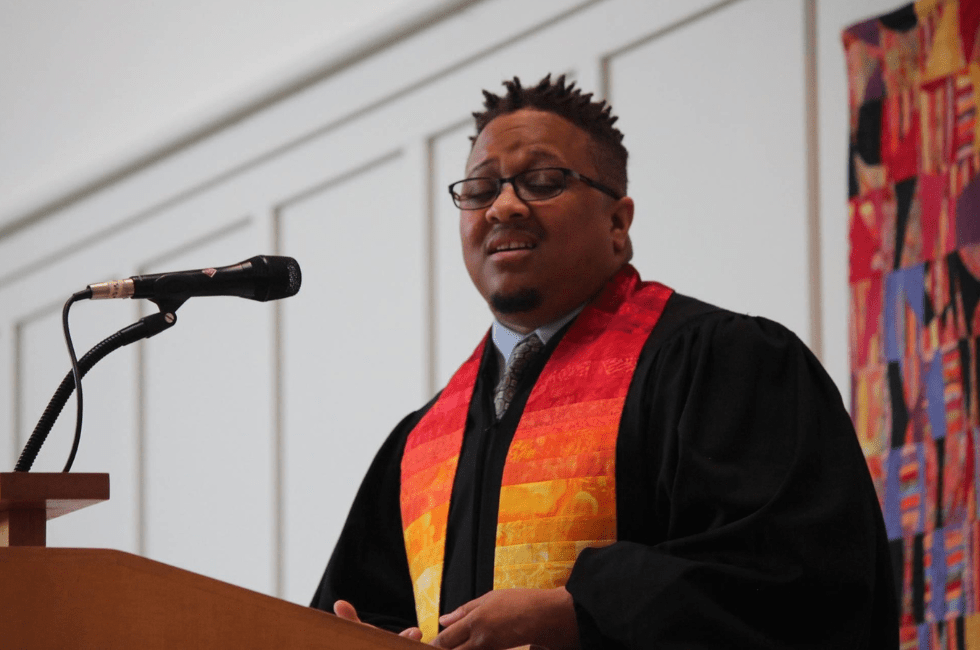
While use of the term “worship” is complicated for many UUs, I arrive clear that these moments of honoring and blessing, however we choose to name them, capture body, mind, and spirit most when they are dynamic, love-centered, and representative of our full humanity. Feeling a sense of belonging in our congregations isn’t just about how we greet one another, which programs we offer, or how we support new leaders, although all of these things are meaningful considerations for a community invested in its own thriving. It matters just as much how connected and cared for people feel in ritual space, even and especially if folks don’t realize going in that that’s what they need. Connection and care make way for attentiveness, openness, and possibility and are central to my work as a minister in these contexts.
Preaching is a multi-layered art form meant to bring us all (even the preacher) closer to what helps our UU faith come alive in us. It’s not just a talk meant to impart knowledge about something we may not know much about. So my preaching is inspired, coming with a great deal of attentiveness to not only what’s going on in the world, but also to what’s happening within the confines of the congregation. When I’m guest preaching, I always ask what the congregation is moving through as a people. What would be of service to their growth and understanding about how to be better UUs? I enjoy preaching very much. I also believe that the preaching moment can happen in all sorts of creative ways and I delight in collaboratively working with other staff to offer meaningful moments to the community.
Pastoral care and spiritual guidance
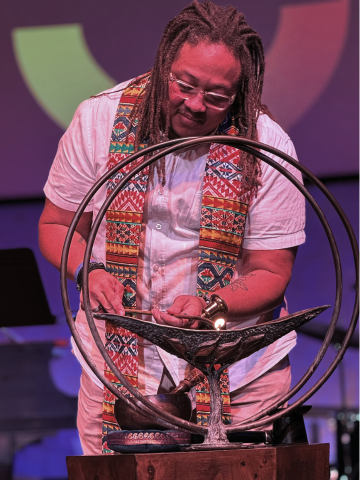
Ministry is not only about presence, but also awareness. Both help build trust and a sense of connection that can put the people of a congregation at ease with anyone new to the staff of a congregation. I believe that part of my role as minister is to provide pastoral care when needed/requested and to offer spiritual guidance all along the way, both in how I’m connecting Unitarian Universalism to our lived experiences and in how I’m modeling community-oriented care and accountability. I am not a licensed counselor and so will not be providing counseling, but I am happy to encourage folks to seek out or continue counseling, if my time with them seems to present a need for longer and larger scaled support and care.
Lifespan religious education
Supporting programming that brings Unitarian Universalism to life for our children is a major part of growing our faith and will be vitally important in any community I serve. And I don’t believe this has to happen solely within the confines of the congregational setting. I really believe what Karen Bellavance-Grace says in her essay “Full Week Faith” when she talks about bringing Unitarian Universalism to families and not always expecting families to come to the church building for an education. In this digital age, people have different expectations and understanding around what it means to “show up” for church, and notions of volunteerism have changed. So I would encourage and support, however I can, parents and guardians, right alongside religious educators and youth coordinators, to take an active part with their children, with care and resourcing from the congregation, in discovering the depth and breadth of Unitarian Universalism all around us. It’s not just about the words we use, the illustrations we present, or the crafts we create. It’s about the lives we continuously learn how to live better.
My primary approach to youth and youth work as a minister is to get to know the youth in the community. What drives them; what encourages them? What is their given and chosen family life like? What does thriving mean in their lives? What are they most fearful of in the world we’re living in right now? And none of this learning is possible without building trust first. So I would make the time to build that trust and work with youth coordinators as they build/sustain a robust program for youth with all these questions in mind.
I don’t believe that religious education is just for children and youth. We all have things to learn about our Unitarian Universalism and how it connects to what we hold most dear in the life we know and whatever may or may not exist beyond the life we know. Adult religious education matters, both because we move through ebbs and flows of life that invite us to ask deeper questions about our existence and because we may have people in our lives of every age who are seeking connection around such inquiry and our engagement as adults helps to build and grow healthy, honest, and caring multigenerational, multifaith communities.
Community building, facilitation, and social time
We UUs are a wide range of communities within communities, and my approach to that is to understand who is in the room and what needs and hopes exist within them. Understanding who is in the room takes patience, a commitment to ask real (and sometimes challenging) questions, and recognition that time is our friend; it’s about being a good facilitator and holder of space. I have been a facilitator for nearly twenty years and am highly skilled at and unafraid of holding spaces with people of varied lived experiences.
Coffee hour and social times can be incredibly valuable, as long as longstanding community members are clear about their role in those spaces. They are spaces of deep connection and can foster a sense of belonging, and so I am clear that my role as a minister is to be present in those spaces. And those of us who are more comfortable have to be ready to usher in folks who may not have as firm a grounding in the community. Without that, those spaces can be isolating and harmful.
Mission, vision, and covenant
Unitarian Universalism, as an orientation toward love, justice, and liberation, is deeply important in a world where we are all not yet free. And so it matters that our commitment to our faith settles deep in our skin and bones and is ever present in the communities we call home. Because of this, UU congregations have a unique responsibility to our people and to the local and global community, and long-range planning is tantamount to how we honor that responsibility.
My approach as a minister is to ensure that all the staff and programming leads of a congregation are actively involved in the process of long-range planning. Siloed ministries can feel isolated and without grounding, so making time to recognize common goals is deeply important. It is easy to lose sight of mission and vision when the everyday is overwhelming, and helping folks stay on track really matters. It is also part of my work to ensure that everyone engaged in this process covenants to be together in it with respect, clarity, and grace.
It is so easy a thing for the sound of the genuine in us, as individuals and as whole communities, to get lost or pushed aside by expectations and old stories that have taken up residence in our bodies, our minds, and in systems that we have grown comfortable with. My approach to ministry in a congregational setting is to discern together, with all the staff and leaders, what the sound of the genuine truly is in the community and develop and honor a mission and vision that align with that sound.
Anti-oppression work
I tend toward hope, and, in general, believe in people and their ability to make their way (or make their way back, if they’ve veered off too far) to the path of love. I’m a Universalist, after all. This means that it is part of my spiritual practice to fuel that belief by looking for and making way for that possibility. I like how bell hooks put it in Teaching Community: A Pedagogy of Hope when she noted that “while it’s true that we’re born into a racist society and are socialized to live as if that’s our only option, it is equally true that people can make the choice to resist that socialization.” That choice, over and over again, is a spiritual practice for me and one that, I believe, we have countless opportunities to model for one another, and I would hope to talk about and live into this in any community I serve.
Anti-oppression work is spiritual work because it calls us to do the work of dismantling supremacist systems without the certainty of easy or fast outcomes, but with the understanding that it will heal more than it will harm local and global communities, even if we don’t live to see it come to pass. This work can give us the strength to not be beholden to systems of belief that aren’t set up for everyone’s thriving. If I am not beholden to those systems, others might know they don’t have to be either. It takes practice to undo those systems’ hold on us. This is why it matters that the actual work of dismantling systems of oppression continue.
Social justice/social action
It matters that each of us has what we need to thrive in the world—“no matter where we’ve been or what we’ve done.” And as many resources as there are in this country and in the world, there’s no reason why it can’t be so. This is why our organizing matters. This is why coalition-building across a wide spectrum of communities matters. This is why we can’t just talk about dismantling supremacist systems, but actually do the work of disrupting them, in both small moments and in great waves. The relationships we cultivate help us understand the broader needs and what our roles are in seeing that those needs get met.
I believe my ministerial approach to this work is to be present for it, remind people in the community about the value of it, and support the building of educational/faith formation models that will help people understand the deeper work of relationship and coalition building, organizing, and disruption.
Stewardship and finances
My approach to stewardship is relational. Yes, it matters that the church has what it needs financially, and it seems to me that folks are more invested in giving when they have more opportunities to talk about and live into why giving matters. People want to feel a sense of belonging in their congregation and that begins with honest engagement and relationship. What makes the community great? What, if anything, about the community worries you? What feels life-giving? What doesn’t feel as fruitful or worthwhile anymore? This kind of sharing cuts through numbers; it builds community and reminds people why they’ve made a home in Unitarian Universalism.
Attending a weekend retreat on fundraising for social change led by Kim Klein offered me significant learning about the responsibility of every person to invest time in fundraising and supporting the financial health of any organization or community. It’s about connecting to mission and vision beyond the day-to-day work. Finances and stewardship are connected.
It is also my hope to work with skilled staff and lay leaders to ensure that the congregation is doing everything it can to maintain a solid level of financial stability, through stewardship and other opportunities to increase revenue streams of the church.
 Rev. Mykal Slack